| Rating: | 5 (1 votes) |
| Played: | 39 times |
| Developer: | Azgames |
| Released: | Friday, October 9, 2026 |
| Classification: | Casual Games |
Flip Physics is a gymnastics simulation game featuring a ragdoll character: swing on bars, let go, spin in mid-air, and catch the next bar to build a long combo chain.
You control a ragdoll gymnast hanging from a bar. Every movement is governed by physics, so whether you pull off a spectacular flip or a hilarious wipeout, it’s all down to your timing and input.
Once you catch a bar, repeat the rhythm to extend your chain of moves. Missing a catch causes the character to fall, but the falls are usually so funny that players rarely get frustrated.
Swinging here is more like using a playground swing than doing pull-ups. You don't need brute strength; you just need to push with the right rhythm.
Repeat a few times, and the swing amplitude will gradually increase.
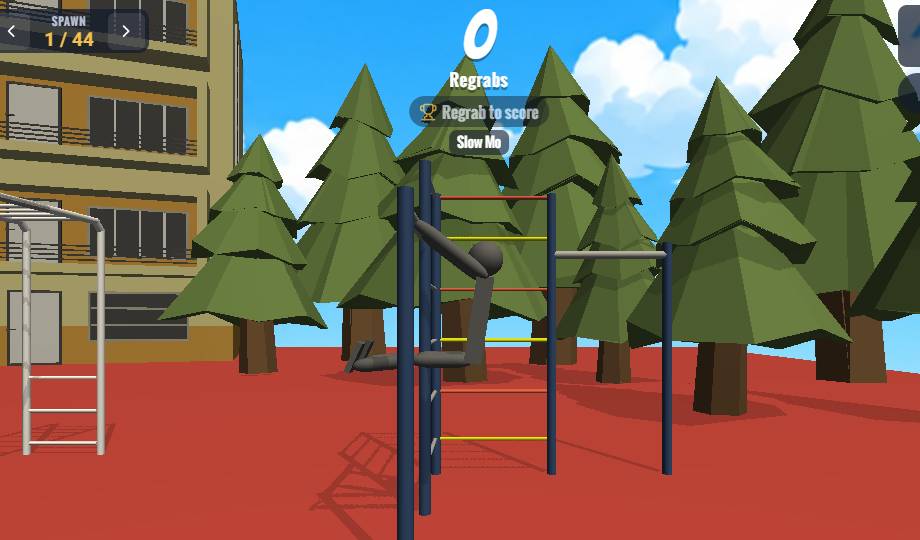
The moment you let go matters most. The angle and speed at that instant set your entire flight path.
To practice, choose one spot on the swing arc and let go there every time. With a fixed reference, you can see exactly what goes wrong when a attempt fails.
After you leave the bar, your only control is body position, and it works like real physics.
Easy to remember: tuck to spin, open up to stop. Before you reach the next bar, open up so you face it. If you are still spinning fast, the grab is hard to land.
The controls in Flip Physics are simple: swing, let go, spin, grab. The challenge lies in seamlessly connecting those moves. You have to get a feel for momentum, and that only comes from repeating it until your hands know the rhythm on their own. If you enjoy physics-based games that require precise timing and movement control, give Wacky Walk a try as well. It’s a sensible choice for a change of pace after performing flips on the bar; it retains that ragdoll humor while offering a different style of gameplay.
Casual Games