| Rating: | 4.2 (20 votes) |
| Played: | 856703 times |
| Developer: | Azgames |
| Released: | Monday, August 24, 2026 |
| Classification: | Casual Games |
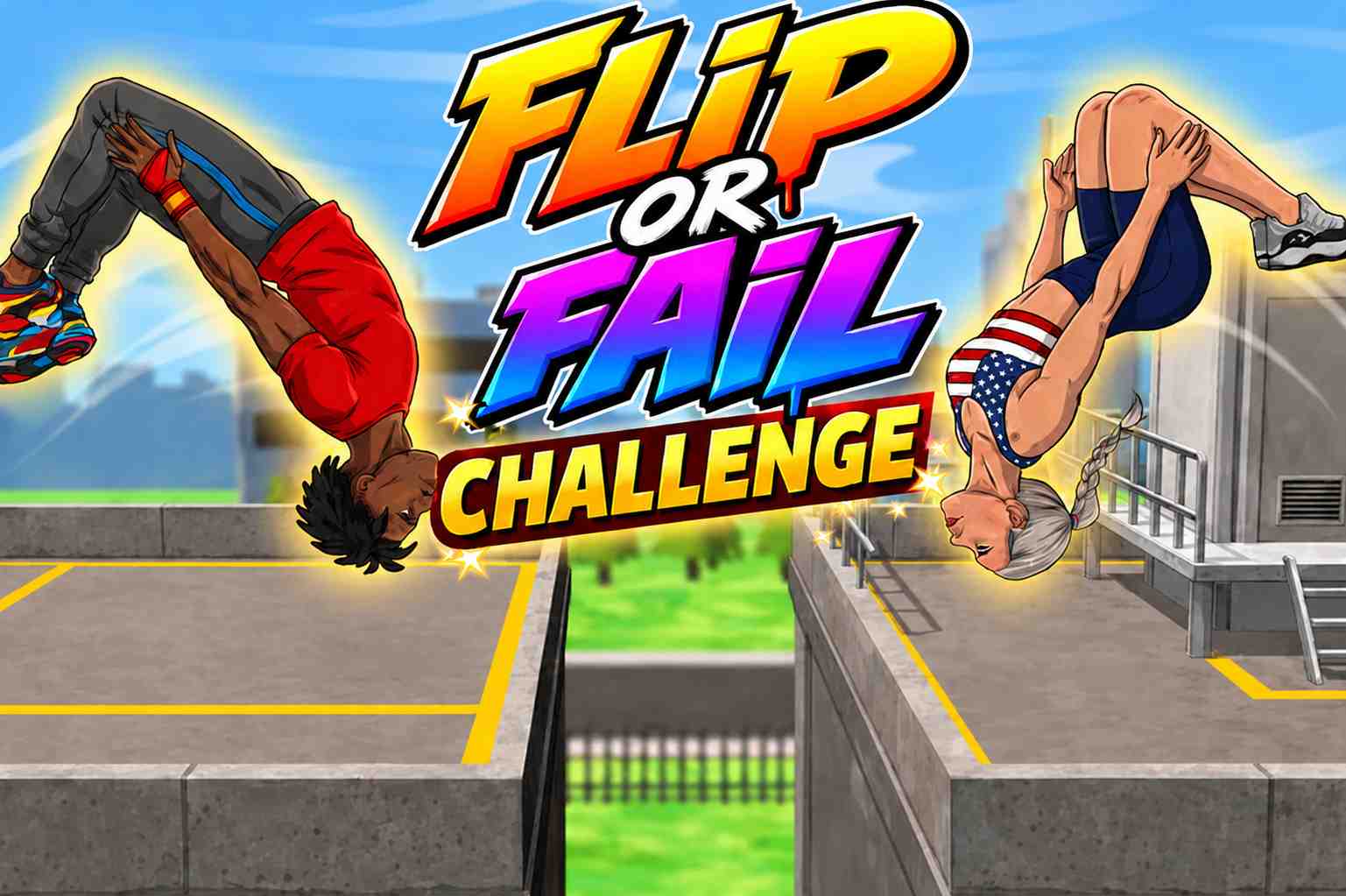
Flip Or Fail is a physics-based arcade game where getting the timing right is everything. You launch your character from a platform and must control its spinning body. A good flip can give you a nice score, but if the timing is off, you will usually end up falling in a funny ragdoll-like way.
Going for more rotations can increase your score, although there is a trade-off. The more you spin, the less time you have to get your character ready for the landing. Each level gives you another opportunity to get used to the movement, and failed jumps Each level provides another chance to familiarize yourself with the movement, and failed jumps prove beneficial by revealing what went wrong. because they show you what went wrong.
The controls are simple:
After playing Flip Or Fail for a while, I found a few things that made the jumps much easier. These small details can significantly impact your performance as you acclimate to the game.
Before you launch, figure out where you want to land. It sounds obvious, but it is easy to forget when you are focused on getting as many flips as possible.
Knowing the landing spot gives you something to work toward while you are in the air. Your mouse movements become more deliberate instead of just spinning the character and hoping for the best.
A full-power launch sends your character much higher, which also means you spend more time in the air. That might seem like a good thing because you have more time to perform flips, but it also gives you more chances to mess up the landing.
For shorter distances, a jump with moderate power is often easier to handle. Try to match the launch strength to how far you actually need to go.
Holding the mouse for one long spin can be tempting, especially when you want to get several rotations quickly. The problem is that once the character starts spinning too much, it becomes harder to correct the position.
Shorter rotations give you more control. You can make one movement, check the character's position, and then make another adjustment. It takes a little more attention, but stopping the spin at the right moment becomes much easier.
One of the easier mistakes to make is releasing the mouse too late. You don't want to wait until the character has already touched the ground.
If you are still holding the mouse when the character lands, the rotation can continue and throw off the landing. Try releasing it just before the feet make contact. This gives the character a moment to straighten out instead of carrying the spin into the landing.
Not every failed jump is a bad attempt. Occasionally the way your character falls tells you exactly what needs to change.
If you rotate too far, you know you need to slow the next attempt down. If you come up short, you may need more jump power or a different rotation. Watching these failed landings and making one small adjustment at a time is a much better way to improve than simply repeating the same jump over and over.