| Rating: | 3.5 (3 votes) |
| Played: | 2239 times |
| Developer: | Azgames |
| Released: | Monday, August 17, 2026 |
| Classification: | Casual Games |
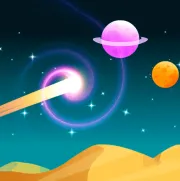
Planet Merge is a fun puzzle game where you merge planets. Simply drag and drop to combine them, and help Sputnik transform into the Sun. Play now to defy gravity and navigate a confined space!
Planet Merge centers on Sputnik, a tiny satellite with a big dream: to become the Sun. It may sound far-fetched, but this is how Planet Merge turns a familiar merging mechanic (reminiscent of 2048 or Suika Game) into an emotionally engaging journey. You aren't just clearing the board; you are powering a character through ten stages of cosmic evolution.
Use your mouse to merge the adorable planets:
When two planets of the same type touch, they merge into something bigger. That much you'll figure out in your first ten seconds. But the game's real charm shows up once you realize the action doesn't stop the moment you let go of the mouse. Gravity keeps working on the planets after that, sometimes setting off a chain reaction you never saw coming. Every so often it hands you a lucky combo; other times it quietly wrecks a setup you'd spent the last three moves arranging.
That's precisely why picking your shot angle is never as simple as "aim for the nearest gap." Players who are skilled at this game tend to think one or two moves ahead, placing a planet in a location that may seem like a mediocre choice at the time but actually sets the stage for a larger merge in the next turn.
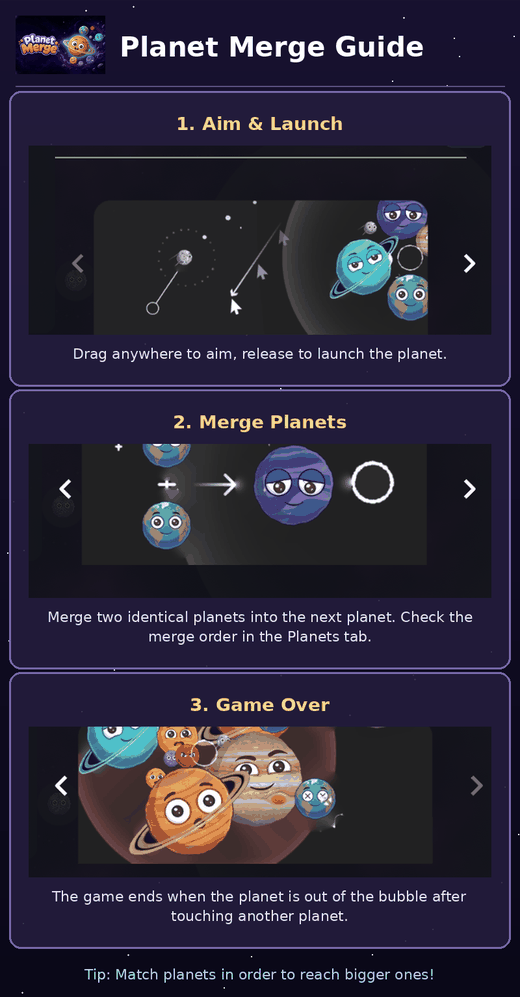
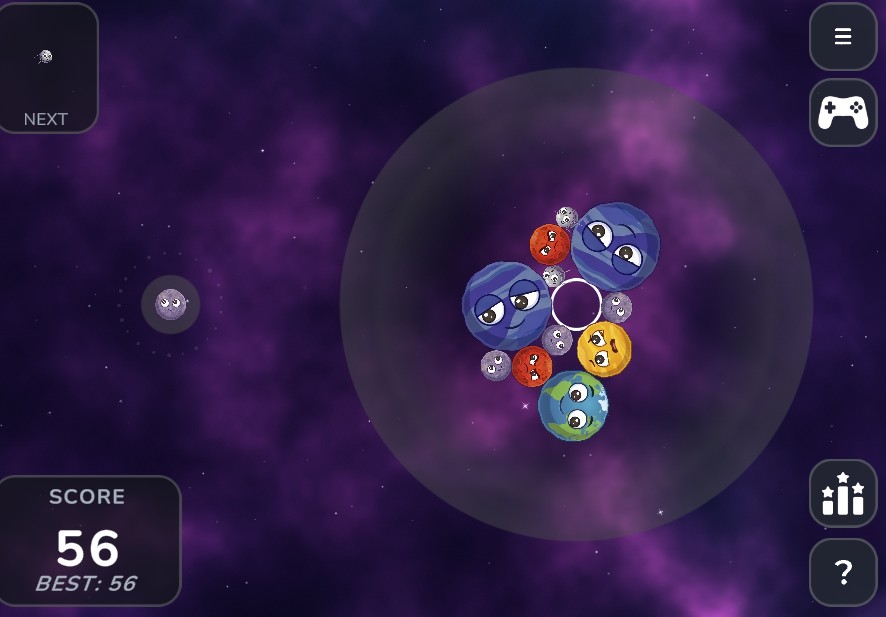
This is arguably the cleverest piece of design in Planet Merge. The bubble that contains your planets has a limited capacity. So every time you land a successful merge, the planet that comes out the other side is bigger, and it eats up noticeably more of that fixed space than the two smaller ones it replaced ever did.
In other words, every time you make a "winning" move, you also make things harder for yourself in subsequent turns. Space steadily shrinks, yet the pressure to keep merging and racking up points remains constant. If even a single planet accidentally drifts beyond the bubble's boundary, the game ends immediately—no matter how well you played beforehand.
Beyond chasing personal bests, Planet Merge features an achievement system distinct from the scoring mechanic. Some goals simply encourage experimenting with different playstyles, rather than just rushing to merge as quickly as possible. This gives players a fresh reason to return for another round, rather than just mindlessly repeating the same actions to beat a high score.
If it relied solely on gravity and confined space, Planet Merge might become genuinely stressful. However, the developer, Azgames, cleverly "cools things down" by turning each planet into a lively character, complete with a smiling face and curious eyes, that seems to watch you navigate the chaos you’ve created.
Resist the urge to fire at whatever gap is closest. Take a beat, scan the board for planets of the same type, and try to land your next one somewhere near them, even if that spot looks a little awkward at first glance. What feels like a mediocre placement now often sets up a much bigger merge a turn or two down the line.
Large planets are best parked toward the bottom or the corners early on, freeing up the center and upper zone for maneuvering later. As a rule of thumb, the bigger the planet, the sooner you want it settled; leaving it to drift near the middle just eats up space you'll need down the road.
Once it leaves your hand, gravity takes over, and the planet can trigger a chain reaction you didn't plan for. You won't have precise control at this stage, but you're not entirely at its mercy either; launch angle and speed both provide you a rough sense of where things will settle. Shots that are too forceful or too far off-axis tend to be the ones that spiral into chaos.
Get in the habit of checking how much open space you actually have before every shot, especially once the board starts filling up with larger planets. One thing to watch for: stacking too much weight on a single side tends to create an "overflow" effect that can knock a planet clean out of bounds.
Not always; that instinct can backfire. Chasing every possible match without tracking your remaining space is a quick way to run out of room. There are moments when it pays to skip a merge entirely, using the turn instead to reorganize or clear space, rather than forcing a combination just because you can.
Longevity matters more than any single big play. Since your score builds up through the total number of successful merges, staying alive longer usually beats trying to force one massive planet early. Keep the board breathable, and the points will follow.
They often do. Some achievements push you toward an entirely different approach than pure score-chasing—merging in a particular order, for instance. Occasionally stepping outside your usual routine is more beneficial than consistently relying on the same playstyle for every run.
Before worrying about your score, spend some time just watching how gravity behaves after a drop and how same-type planets react on contact. Once those two mechanics click, every placement decision that follows becomes noticeably easier to judge.
Planet Merge boasts incredibly simple mechanics, using physics and spatial limits to create a natural, escalating sense of pressure. You won't find the game frustrating you with convoluted rules; instead, the challenge arises from your choices regarding planet placement, and that is precisely what keeps players coming back for more.
Searching for a change of pace after a few rounds of Planet Merge? Give Wheel Quest a try—it’s a new game available on our website.